1. Why oracles are the lifeline for predicting the market
The entire trust chain of the prediction market is built on settlement accuracy:
- 1.Bettor win/lose judgment → Depend on settlement results
- 2.Settlement results → Depend on the fact that events actually happened
- 3."The event actually happened" and posted online → Rely on oracles
If the oracle is wrong, the whole chain collapses. Several settlement disputes in Polymarket's history have stemmed from oracle selection.
Most budget overruns are not due to development itself, but rather from underestimating supporting facilities and long-term operations. A chain without a browser or toolchain, which developers can't use, is an isolated island.
2. Three forms of oracles
Designate oracle: The project team designates an authoritative source (such as Chainlink) as the basis for settlement. The advantage is simplicity; the downside is centralization—if the oracle is attacked or bribed, the market is doomed.
- 1.Multi-source weighted oracles:Multiple independent data sources, weighted to draw conclusions. Reduces single-point failures but increases complexity and latency.
- 2.Optimistic Oracle (UMA Mode):Anyone can submit results, stake tokens, and challenge the wrong result—after the error is corrected, the challenger receives a reward. Most decentralized, but with a 24-48 hour latency.
For large event markets, UMA is used; for small events, designated/multi-source is used. This is Polymarket's final hybrid solution.
3. Engineering implementation of multi-source verification
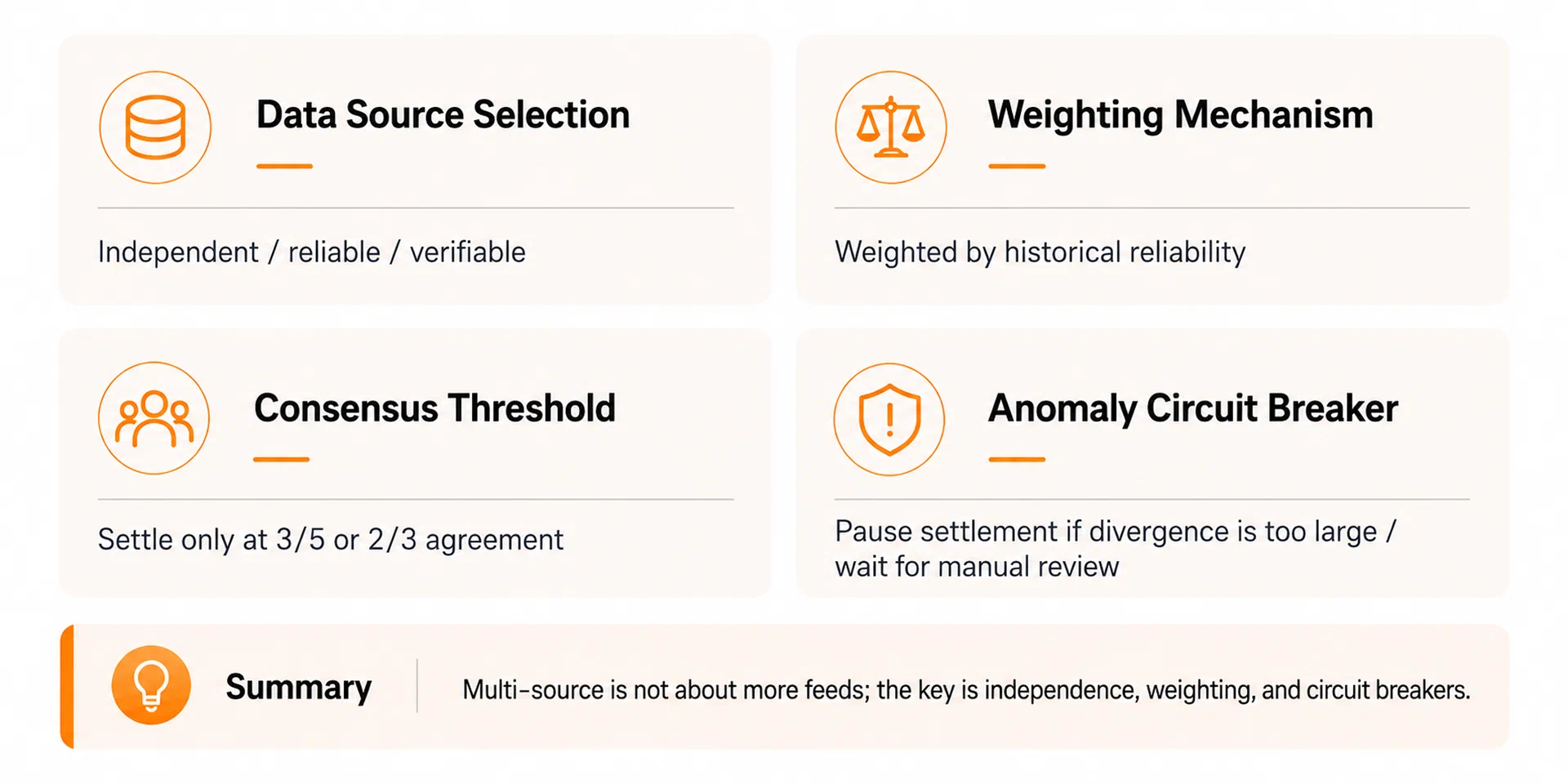
If choosing a multi-source solution, the key design is:
- 1.Data source selection:Independent, trustworthy, and verifiable (such as ESPN, Bloomberg, official API)
- 2.Weighting mechanism:Weighted by historical reliability of data sources
- 3.Consensus threshold:For example, settlement is only made if 3/5 or 2/3 matches the same
- 4.Abnormal circuit breaking:If data source discrepancies are too large, settlement is suspended to wait for manual intervention
4. Dispute Arbitration Mechanism
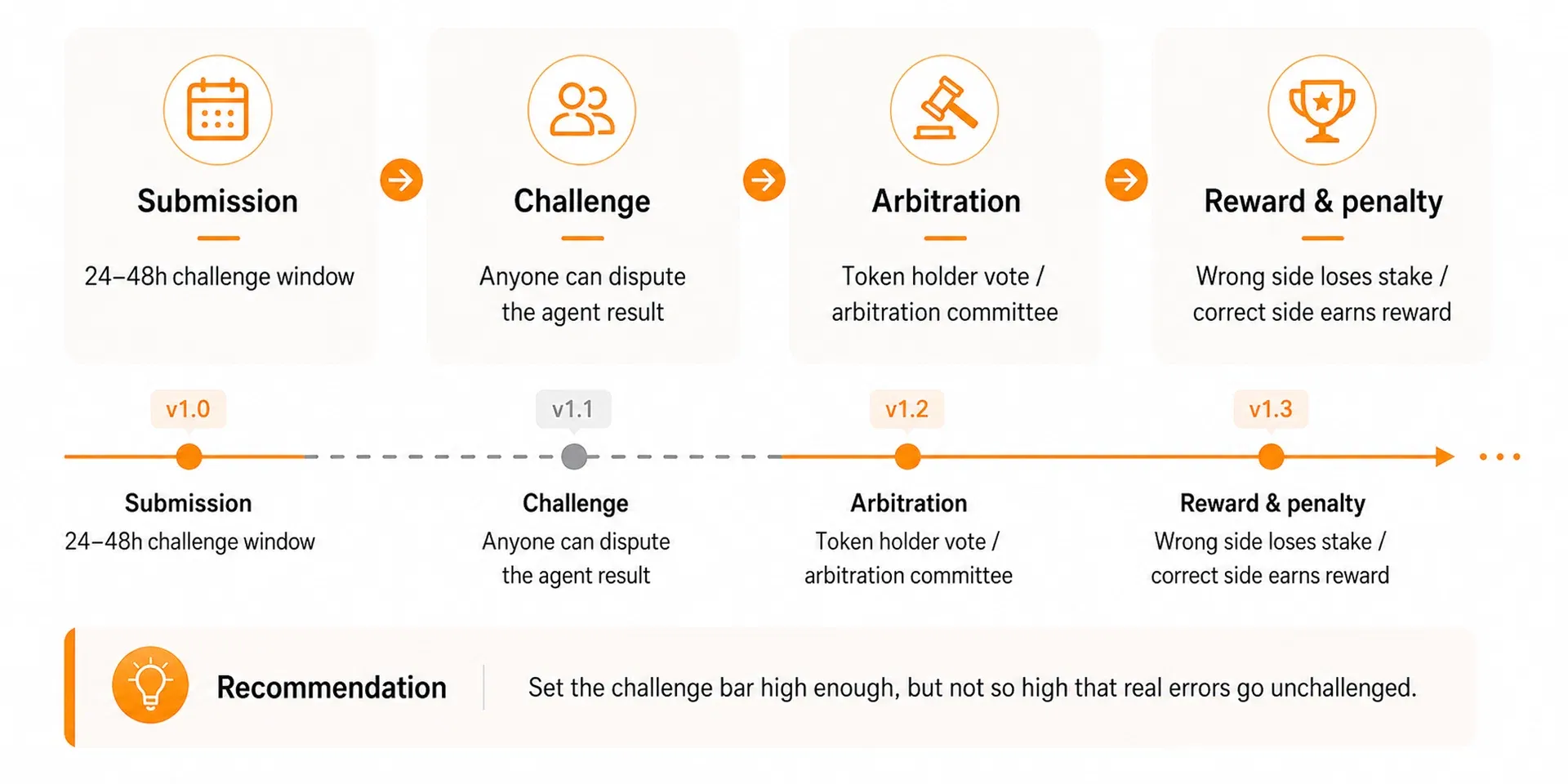
No matter which oracle is used, there must be a dispute mechanism. Common designs:
- 1.Submission period: After the oracle provides the results, the challenge period begins within 24-48 hours
- 2.Challenge: Anyone staking tokens challenges the results
- 3.Arbitration: Token holders vote, or a dedicated arbitration committee decision
- 4.Rewards and penalties: The incorrect party loses the stake, the correct side receives a reward
The key is that the challenge threshold must be high enough to avoid malicious challenges; But it can't be too high, or the real mistakes will be challenged by no one.
5. Handling of boundary events
The hardest part of predicting the market is not "obvious right or wrong," but the boundary situation:
- 1."Will Bitcoin break $100,000 this year?" → If it drops again just one minute after the breakout, does that count?
- 2."Will a candidate win?" → What happens if the election is postponed, canceled, or overturned by the court?
- 3."Will a company go public?" → If a company is acquired, how does the market settle?
These scenarios need to be set by clear rules at the time the market is created. In a market with ambiguous rules, disputes are bound to arise.
In the market prediction, oracles and dispute mechanisms are not "functions," but "the product itself." Make it the core of it.