1. Why Royalties Can't Be "Forced On-Chain"
Key fact: The NFT contract itself does not know whether a transaction has occurred. When an NFT is transferred from address A to address B, the contract only sees the transfer action and does not know:
- 1.Is this a free transfer or a paid transaction?: No price information
- 2.If it's a transaction, what is the price?: No trading context
- 3.Funds go wherever they come from: Only outbound/inbound addresses
Therefore, the execution of the "5% royalty" relies on market platforms actively calling royalty contracts and paying them. If the market doesn't call it, the royalty is zero.
Most budget overruns are not due to development itself, but rather from underestimating supporting facilities and long-term operations. A chain without a browser or toolchain, which developers can't use, is an isolated island.
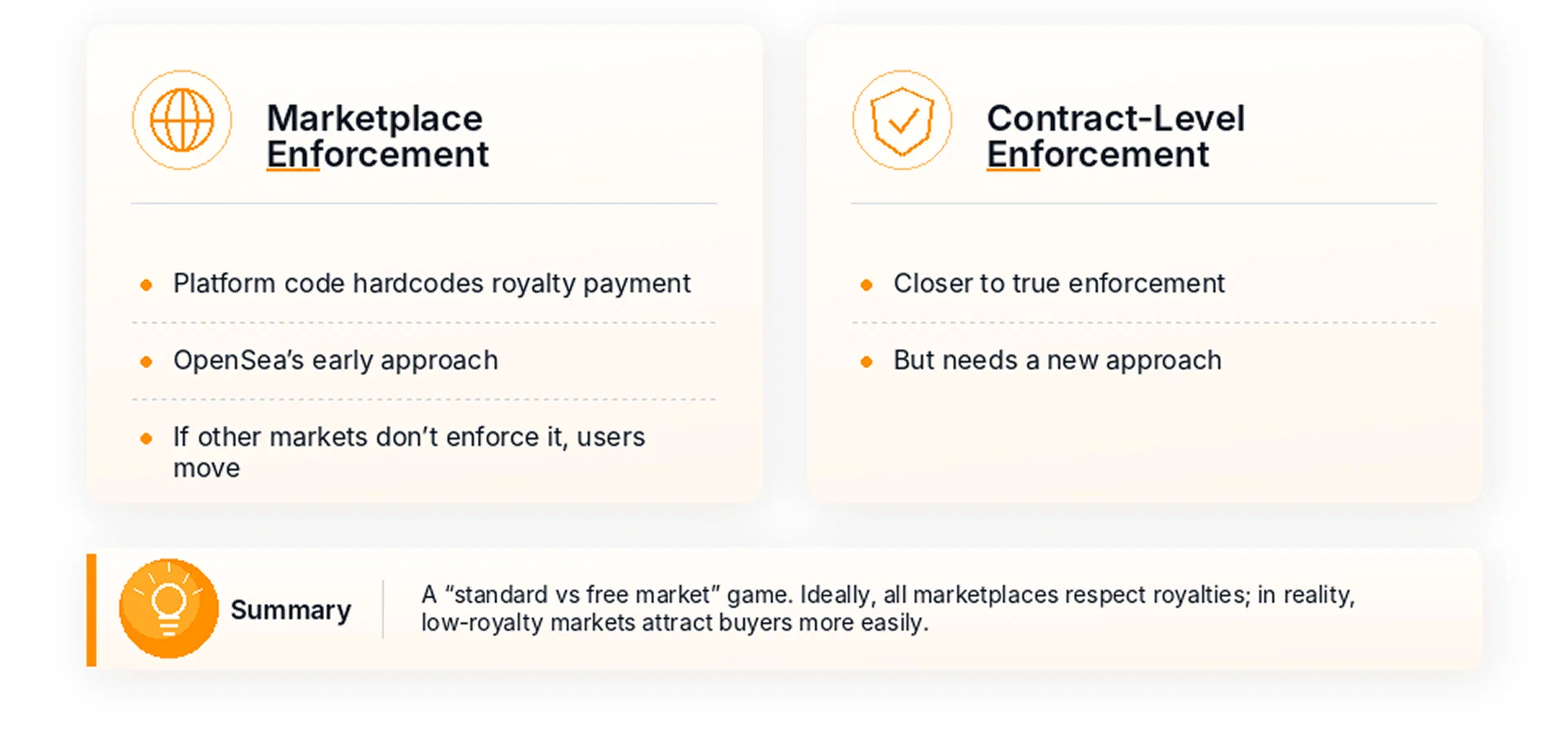
2. Market Layer "Mandatory" vs. Contract Layer Mandatory
"Market layer mandatory implementation" was OpenSea's early practice: platform code was written in the platform code to pay royalties. But other markets didn't enforce it, so users went there—OpenSea later withdrew it too.
"Contract-layer coercion" is closer to "true enforcement" but requires new ideas.
This is a typical "standard vs. free market" game. The ideal is that all markets respect royalties; in reality, markets without mandatory royalties attract more sellers—this is a copy of Gresham's Rule in Web3.
3. Contract-layer mandatory solutions
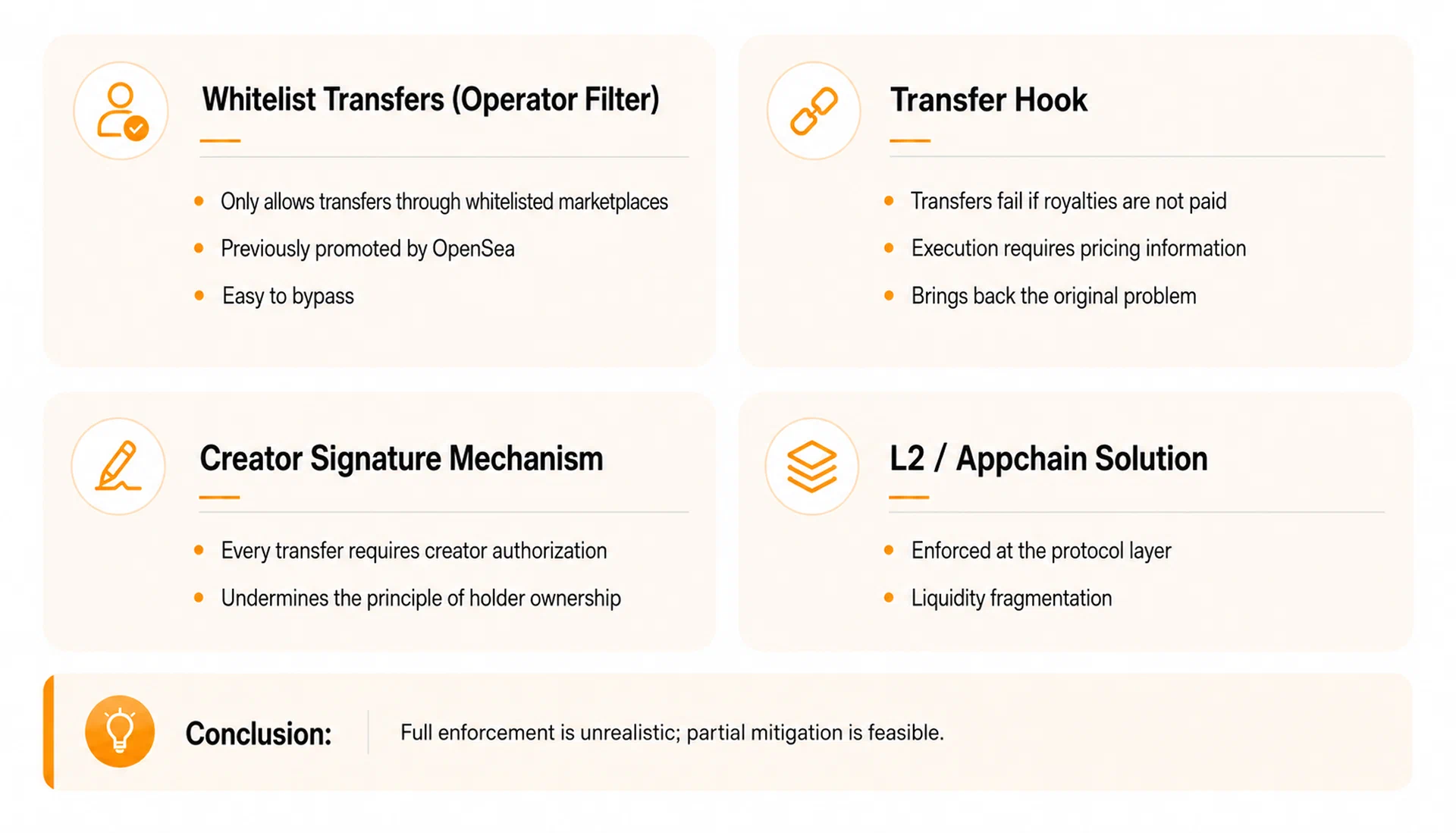
Several engineering attempts:
- 1.Whitelist Transfer (Operator Filter):NFT contracts only allow tokens to be transferred to the market listed on the whitelist. OpenSea pushes through, but is easy to bypass
- 2.Transfer hooks to burn tokens that do not pay royalties:Turning "no royalties without payment, no transfer" into contract logic—but execution requires price information, returning to the first question
- 3.Original author signature mechanism:Each transfer requires creator authorization—undermining the "holder-own" principle of NFTs
- 4.L2 / Application Chain Solution:On dedicated chains, it is enforced by protocols—but liquidity is fragmented
Conclusion: Fully enforcing is unrealistic; partial mitigation is feasible.
4. Real conflicts of interest among all parties
The fundamental reason this problem remains unresolved is the disagreement of interests:
- 1.Creator:Hope for mandatory royalties
- 2.Seller:Hope to pay less royalties (directly affecting income)
- 3.Market:Hope to attract more sellers (no mandatory royalties = competitive advantage)
- 4.Buyer:Relatively neutral, but cheap NFTs are always better to buy
Market competition pressure has prevailed in the "non-mandatory" market. This is an economic law, not a technical issue.
5. Suggestions for the project team
If you are working on an NFT marketplace project:
- 1.What the contract layer can do:The whitelist + signature mechanism increases the cost of violations
- 2.Designing royalties as "value incentives" rather than "mandatory taxes":Buyers who pay royalties receive ongoing creator benefits (airdrops, communities, new version priority purchases)
- 3.Transparent Display:Allow buyers and sellers to clearly understand where royalties go for each transaction
- 4.Don't promise "absolute mandatory":If technology can't do it, the promise is debt
Royalties are not a technical issue, but a design incentive issue. Turning buyers into royalty supporters is more sustainable than coercion.